oecdecoscope posted: " By David Crowe, Valentine Millot and Łukasz Rawdanowicz, OECD Economics Department Due to the COVID-19 crisis, sovereign debt in relation to GDP has increased massively, reaching the highest levels in several decades in many countries. Current low int"
By David Crowe, Valentine Millot and Łukasz Rawdanowicz, OECD Economics Department
Due to the COVID-19 crisis, sovereign debt in relation to GDP has increased massively, reaching the highest levels in several decades in many countries. Current low interest rates reduce concerns about debt sustainability, but high debt makes public finances vulnerable to negative shocks. Thus, governments will have to balance the need to minimise the risk of fiscal stress and the need to satisfy growing demands on public finances.
In this context, in our recent paper Constraints and demands on public finances: Considerations of resilient fiscal policy (Rawdanowicz et al., 2021), we analyse 17 episodes of large and prolonged sovereign debt reductions in OECD countries since the 1970s. We find that such debt reductions were achieved primarily by increasing budget surpluses, supported by a context of strong nominal GDP growth (on average 7%). Debt reduction episodes were initiated in response to rising debt and interest payments, sometimes resulting from economic crises. It is noteworthy that in some cases debt reduction episodes were accompanied by revamping fiscal frameworks.
There are many examples of large and prolonged debt reductions
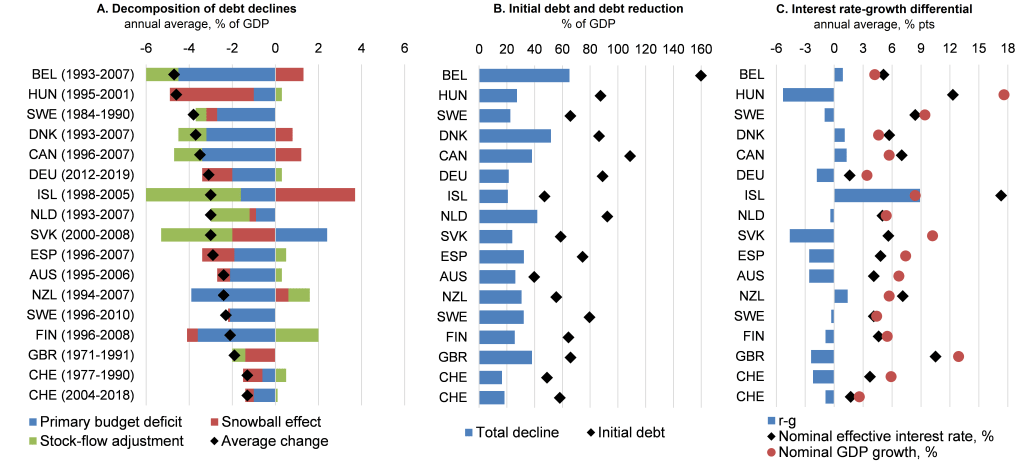
We identify 17 episodes that involved persistent reductions in gross debt (spanning at least five years, but allowing for temporary debt reversals) of at least 15% of GDP, in contrast to a traditional focus in the literature on fiscal consolidations which are measured by changes in budget balances – e.g. (Molnár, 2012) (Figure 1). Most of the episodes started in the 1990s and ended before the global financial crisis. On average across the episodes, debt was reduced by just over 30% of GDP over 11 years, but the size and duration varied across the episodes (Figure 1, Panel A). In many episodes, initial debt was no higher than 80% of GDP and, in most cases, the debt‑to‑GDP ratio was reduced by less than half (Figure 1, Panel B).
Figure 1. Episodes of large and prolonged sovereign debt reductions: main statistics
Note: Episodes selected based on data availability in the OECD Economic Outlook database. The snowball effect captures the product of lagged gross debt and the interest rate-growth differential (see Annex B of Rawdanowicz et al. (2021) for explanations on the debt dynamics decomposition). Source: OECD Economic Outlook database; and authors' calculations.
High budget surpluses and strong GDP growth were instrumental in lowering debt
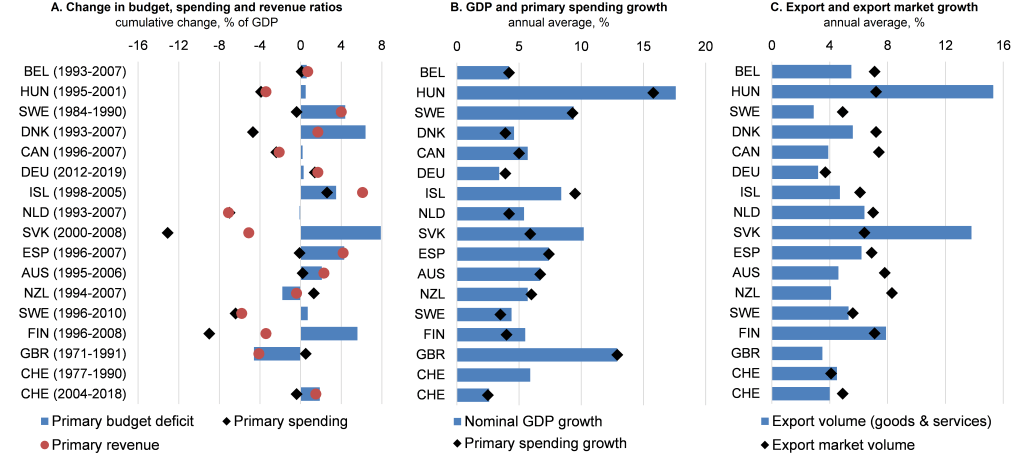
Most of the debt reductions took place in an environment of high nominal GDP growth (on average 7% across countries and years; Figure 1, Panel C), in particular in Hungary and the United Kingdom. The notable exceptions are Germany and Switzerland (2004-2018), where nominal growth was modest but still r-g was negative and the budget surpluses were high. In line with this, in most cases, the primary budget balance‑to‑GDP ratio improved as primary revenue increased by more or declined by less than primary spending (Figure 2, Panel A). In addition, average growth in nominal primary expenditure was not higher than average nominal GDP growth (Figure 2, Panel B). In some countries (e.g. Finland and Canada), the debt reduction episode also coincided with a substantial depreciation of the domestic currency, helping export growth (Figure 2, Panel C).
Decomposing the annual average changes in debt (see details in Annex B of Rawdanowicz et al. 2021) shows that in most of the episodes a high primary budget surplus reduced debt – on average by 2% of GDP per annum, but in some cases by more than 3% of GDP (Figure 1, Panel A). In two thirds of the episodes, higher growth than interest rates lowered the debt-to-GDP ratio (Figure 1, Panel C), with a total contribution of the snowball effect to the debt reduction (i.e. a combined effect of the interest rate growth differential and the lagged level of gross debt) on average close to 1% of GDP per year. A few countries benefited also from favourable stock flow adjustments (i.e. all changes in the debt ratio that are not explained by the budget balance and the snowball effect, like sale or purchase of financial assets). This was particularly the case in Iceland and the Slovak Republic due to very large interest earnings and a sizeable reduction in the ratio of government financial assets to GDP, respectively.
Figure 2. Episodes of large and prolonged sovereign debt reductions: additional statistics
Note: Episodes selected based on data availability in the OECD Economic Outlook database. Export market is calculated as a weighted average of trading partners' import volumes. Source: OECD Economic Outlook database; and authors' calculations.
While the economic and political context triggering debt reductions varied across countries, there were a few common themes
Growing fiscal pressures. In several episodes, debt reductions were initiated following prolonged and large debt accumulations. Falling interest rates and subsequently government interest payments helped the debt reductions in the 1990s. In some countries, at the beginning of debt reductions, interest payments amounted to at least 5% of GDP and in Belgium and Canada around 10% of GDP, crowding out other spending.
Fiscal rules and frameworks encouraged actions to reduce debt. In several EU countries, the requirement to fulfil the Maastricht fiscal criteria (budget deficit no higher than 3% of GDP and government debt below 60% of GDP) ahead of adoption of the euro contributed to public debt reductions. In Canada, to help deal with large budget deficits of provincial and federal governments in the early-1990s, many provinces voluntarily adopted fiscal rules. The Federal government introduced the Spending Control Act between 1992 and 1995 and since then has generally used non-legislated fiscal targets, helping to achieve high budget surpluses in the subsequent years. In New Zealand, fiscal discipline was accompanied by the introduction of a new budgetary framework (the 1994 Fiscal Responsibility Act), building on responsible fiscal management principles. The Act also enforced greater transparency about the fiscal situation and fiscal policies.
Negative economic shocks. In a few countries, severe economic crises required fiscal adjustments, thereby securing popular support for adjustment. For instance, in Finland the deep recession following a financial crisis in the early 1990s prompted the government to implement large cuts in government spending (including social benefits, public sector wages, subsidies, investment, and transfers to sub-central governments), with the aim to restore confidence in financial markets and to achieve a non-inflationary recovery. The impact of these measures on debt reduction was strengthened by the move to a floating exchange rate that led to a sharp depreciation of the local currency. In Sweden, the severe banking and economic crises in the early 1990s led the government to implement several structural reforms covering governance of the public finances, tax reforms, liberalisation of the economy, reforming the welfare state (pensions especially), and promoting an export-oriented growth model. However, we should acknowledge that for these countries, favourable global economic conditions boosted exports, contributing to the resumption of economic growth and debt reduction.
Rawdanowicz, Ł. et al. (2021), "Constraints and demands on public finances: Considerations of resilient fiscal policy", OECD Economics Department Working Papers, No. 1694, OECD Publishing, Paris, https://dx.doi.org/10.1787/602500be-en.
Libertarian Christian Podcast posted: " For this episode we decided to use a recent interview from the Tom Mullen Talk Freedom podcast where we discussed how libertarianism and Christianity meld as a belief system, and some of the big questions covered in Faith Seeking Freedom. Some may "
For this episode we decided to use a recent interview from the Tom Mullen Talk Freedom podcast where we discussed how libertarianism and Christianity meld as a belief system, and some of the big questions covered in Faith Seeking Freedom. Some may argue that libertarianism is based upon selfishness or isolating-individualism; whereas Christianity demands selflessness. How can one be a follower of both? Sadly, many have misunderstood the actual nature of libertarianism, and what it means to strive for liberty.
We discussed how the pursuit of liberty leads to legalizing sinful habits, and how that seems so opposite of Christianity. For instance, legalizing sex work seemingly "supports" extra-marital sex; however, the actual intent behind doing so is for giving people within the sex work trade more freedom to leave, as well as more safety, protection, and outlets. Whereas the current state of prostitution is riddled with human trafficking, coercion, and a lack of ways for anyone within the trade to call for help or leave. The same goes for drug legalization. Though these industries are inherently sinful, it is not the role of human law and governance to regulate man's behavior. Not even the all-knowing, all-powerful God has chosen a world in which he can force His creation to follow all of His commands.
Though many Christians defend closed borders, even using Christian doctrine or scripture to do so, it does not mean that borders are what God demands of us. In fact, we argue that anyone seeking a better life for themselves or their family should do so, as long as they are avoiding the use of violence. In order to define and legitimize a border, a nation must always have the ability to use or threaten immense violence on anyone who dares to cross those lines. Americans can traverse across this nation with almost no hindrance whatsoever, why can't other non-US citizens do the same? A truly Christian society would welcome any weary travelers with open arms, regardless of their nationality or political rationale.
Noxolo Chalale posted: " Nkuliso "Inky" Zondi refuses to take credit for the success of the South African women's national hockey team. Under his tutelage as interim coach, the senior women's side won the Africa Cup of Nations in Ghana in January, beating the hosts in the final."
Nkuliso "Inky" Zondi refuses to take credit for the success of the South African women's national hockey team. Under his tutelage as interim coach, the senior women's side won the Africa Cup of Nations in Ghana in January, beating the hosts in the final.
"The players were fantastic at the tournament," he said. "They responded to my challenge and my demands on them as athletes."
His unwillingness to take the credit for their success is perhaps reasonable given that South Africa have won seven of the eight editions they've contested since the tournament's inception in 1990. In a way, success was always "guaranteed".
But what makes his success notable, and something in which he should take pride, is the racial barriers he has broken down. Hockey has a history of being viewed as the preserve of white people in South Africa, where racist laws – even in sport – denied Black people many opportunities. Even in post-apartheid South Africa there have been accusations of racism in the sport, with Black players not given a fair chance. The sport has been slowly moving towards addressing those concerns to produce more transformed national teams.
It is because of these transformation objectives that Zondi, who comes from the coastal tourist town of Amanzimtoti in KwaZulu-Natal, has been in the association's coaching structures since 2015. But to be head coach of the senior national team, albeit not permanently for now, makes a big statement. And to have them succeed despite being thrust into the deep end at short notice speaks volumes about the 33-year-old's technical and leadership abilities.
"Maybe my appointment is a tribute to where the sport would like to move. Maybe this is the start of something that moves us towards that. I believe that now, because of it, everyone can claim hockey as their sport irrespective of their colour or creed. About me being the first Black coach, of course it is special. It is something unique for me to treasure forever. But I don't feel any less confident, because I am aware of what I've had to sacrifice to get here. Still, I don't feel like I am the finished article yet. I know I can still grow from this."
'Honour and privilege'
At the team's hotel in Pretoria before they left for Ghana, Zondi was fully aware of the weight of expectation resting on his shoulders, given South Africa's dominance of the continental showpiece in previous years. Yet he did not baulk, and neither was there a hint of overconfidence in his demeanour. If anything, he displayed a maturity at odds with someone in complete charge for the first time.
"I feel a sense of honour and privilege to be leading this team, and I hope to make a positive impact and make sure that we represent our country and those who are supporting us with pride," he said. "Of course we are expected to win it, as we've always done. But we can't be complacent or take things for granted. For me as a coach, the challenge is to make sure that the team improves its performance and once we can do that, the results will come."
17 March 2022: Nkuliso Zondi at the University of Pretoria, where he heads the hockey programme.
He remained grounded after their success in Ghana: "Going into the tournament, I saw it as an opportunity to represent my country. And I was ready for the role because I believed that the job had nothing to do with my skin colour. In any case, I'd been with national teams to major tournaments before, though not as the main man in charge.
"I have been ready to take up the mantle, and somewhere down the line I am hoping that more [Black] people will take encouragement from it. I know that sometimes we can find ourselves in a world of disbelief when these kinds of things happen. I can easily be wondering, is it really me, a young man from KZN coaching the senior national team? But I can't afford to be caught up in that because I've got a job to do.
"I am fortunate in that I am coming into this space having spent a lot of time involved with various teams. I learnt a lot from the successes and failures there and I understand that the sport is special to so many people. I consider myself lucky to have been in the position to step into this role at short notice. The time in the system has been invaluable."
A maturity that is rare
He has certainly earned his spurs. Zondi has been an assistant coach for the national women's team as well as the men's and women's Under-21 teams. He has also been on the senior men's technical team.
"I played hockey at school when I went to Kingsway in Toti. I did well to make it to provincial level and when I went to Tuks [University of Pretoria] I also played. I had some amazing experiences in the sport and of course the dream to represent the country was always there. But it didn't happen and I did not beat myself up about it. I was aware of my limitations and never felt I deserved to be there."
Such maturity is rare. Many sportsmen overrate their abilities and feel hard done by when they're not called up to represent their country. It was while studying business management at Tuks that Zondi got into coaching, although more out of necessity.
"I started coaching as a means to earn extra money as a varsity student. I coached schools around Pretoria, the likes of Cornwall Hill College, Menlo Park and Willowridge. It was through those experiences that I realised I could do this, more than that I became aware that I loved and enjoyed coaching."
He moved on to coaching at the university, where he now heads the hockey programme. The national association soon picked up on his abilities and roped him into their structures. Zondi has a coaching philosophy that works and Hockey South Africa would do well to give him the job permanently, so he can lead the team at the World Cup in July, the Commonwealth Games a month later and beyond these tournaments.
He knows the job is about results, but has learnt from experience – as a player and during his earlier coaching years – that it is just as important to uplift the players. "I want to impact the people I work with in a positive way, so personal connections are the most important for me. After all, people play the game. So I always say: people first, players later.
"It delights me to see them progress as people because of the influence I have had on them as their coach. For example, I have coached Phumelela Mbande since 2011 at Tuks and I've been delighted to watch her grow through the junior national teams and at Under-21 level to her now being a top goalkeeper with the senior national side. And as a person, I see the progress in her life and I am very happy I contributed."
He also believes in putting in the effort, he said. "Work ethic is a big thing in my coaching philosophy. I think something that is true about me and perhaps true for most young Black people is that our upbringing is steeped in humility. A lot of us have been encouraged to work hard and to never take anything for granted. My parents made sure that hard work is the one thing that I valued most in everything I do."
It's all about preparation
Success in Ghana, he said, was a fantastic experience and down to him and the players being on the same wavelength. "We were improving with every game and the good thing was that we were able to control the narrative of each match. We always wanted to win out there and retain the championship, but we started the group game against Zimbabwe a little slow. We actively looked to make improvements after that and I knew in the game against Namibia that we were good to go all the way. We had improved so well, I was really comfortable with our play."
They hardly looked back after that and went on to become champions of Africa once again, earning their ticket to the World Cup. And now that they will be heading to the global event co-hosted by Spain and the Netherlands in July, Zondi – who was on the technical team at the Tokyo Olympics – hopes the team will get the backing they need to make an impact at the global showpiece.
"Now that we are assured of going to the big event, the discussion has to change drastically. We need all the assistance we can get so that we can be competitive at the World Cup. The talent is certainly there and the desire to do well is bigger than ever, but without proper support and good preparation it won't amount to much."
He said South Africa could have done better at the Olympics had their preparation not been hamstrung by the Covid-19 pandemic restricting their ability to play competitive matches against top-class opposition.
"It's very important that we get good preparatory matches. If we can manage to play regularly against solid opposition, we will grow in confidence and our abilities, and that will stand us in good stead for the World Cup.
"Our challenge in South Africa is that the sport is not fully professional as most of our players are either working or are still students. They are not always available and we thus can't have proper camps to prepare. But if the sport was to get serious backing from corporate South Africa and become professional, I believe that we have the talent for us to get to the level of being competitive at major tournaments such as the World Cup and the Olympics."
guestposter posted: " A free talk 'The General Strike of April 1922. The labour movement's opposition to post-Treaty militarism' is taking place in the Central Library, ILAC Centre this Wednesday 6 April from 1-2PM. Dublin City Council Historian in Residence for Dublin Cit"
A free talk 'The General Strike of April 1922. The labour movement's opposition to post-Treaty militarism' is taking place in the Central Library, ILAC Centre this Wednesday 6 April from 1-2PM.
Dublin City Council Historian in Residence for Dublin City (& Saothar co-editor), Dr Mary Muldowney, will be discussing the strike and its impact at this free event.
Ashish Nain posted: " Orion Innovation (Orion), a digital transformation and digital product development services firm, announced that Ranjan Kalia has joined the Company as Chief Financial Officer, effective April 4, 2022. Kalia succeeds Jeff"
Orion Innovation (Orion), a digital transformation and digital product development services firm, announced that Ranjan Kalia has joined the Company as Chief Financial Officer, effective April 4, 2022. Kalia succeeds Jeffrey Robinson, who will continue to play a key role supporting Orion's finance organization, a statement said. Raj Patil, Chief Executive Officer & President, said: "We are pleased to welcome […]




 WordPress.com


