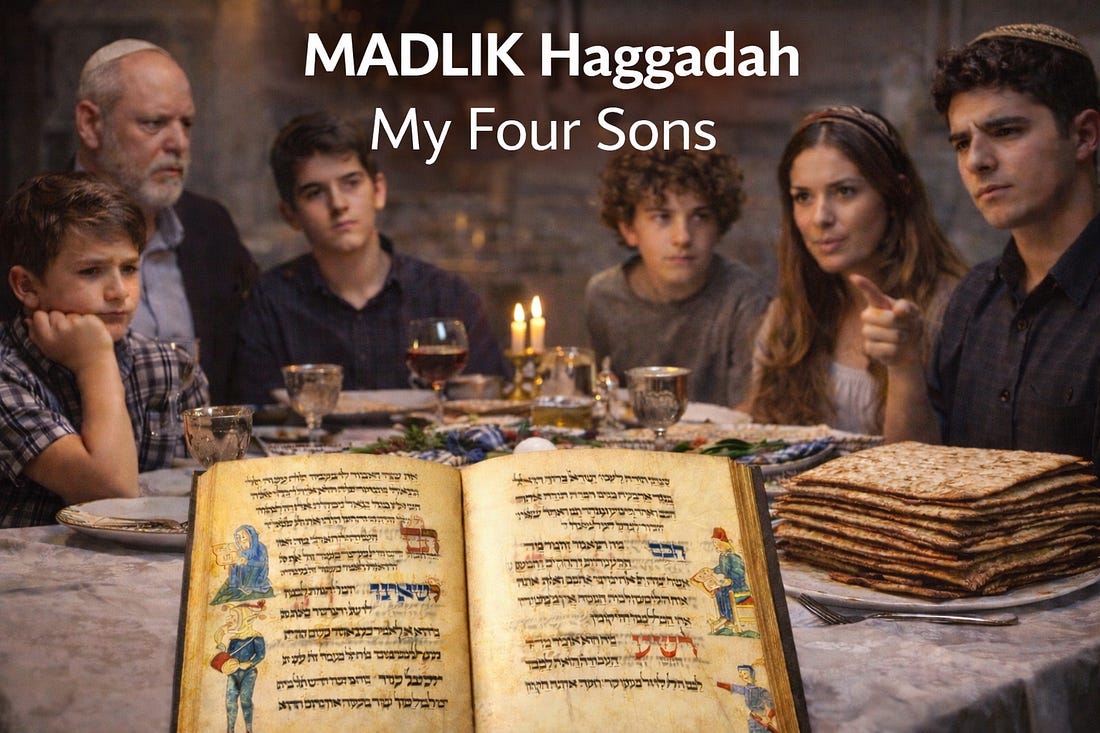
Madlik Haggadah - The Problem With the Wicked Son“Had he been there, he would not have been redeemed”—and why that demands a response
[YouTube video to follow] The Seder may be the most ambitious educational experiment ever attempted. Not because of what it teaches. But because of how. It assumes something radical: That every child learns differently. And then, almost inexplicably— it draws a line. A Night Built for ChildrenEverything about the Seder is designed to capture a child’s attention:
This isn’t a later rabbinic flourish. It comes straight from the Torah. Exodus 13:8https://www.sefaria.org/Exodus.13.8
This verse is actually the source of the name Haggadah. Exodus 12:26https://www.sefaria.org/Exodus.12.26
📖 Exodus 13:14https://www.sefaria.org/Exodus.13.14
📖 Deuteronomy 6:20https://www.sefaria.org/Deuteronomy.6.20
The Torah doesn’t just command us to remember. It commands us to teach. The Rabbis: A Revolutionary PedagogyThe Haggadah gathers these verses and does something extraordinary. It reads them not as repetition— but as differentiation. Four children. And behind this move is a profound educational principle: Proverbs 22:6https://www.sefaria.org/Proverbs.22.6
Or as the Mishnah in Pesachim 10:4 says :
This is not standardized education. This is adaptive, individualized teaching—centuries ahead of its time. And Then the BlessingBefore the children are even introduced, the Haggadah begins:
Blessed is HaMakom—The Place. Talmud Bavli Berakhot 7ahttps://www.sefaria.org/Berakhot.7a
God is the place of the world. And if God is Place— then the Seder is telling us something quietly but profoundly:
And Yet… a Line Is DrawnBecause one of those children is called:
Wicked. And the Haggadah adds: Passover Haggadah – The Wicked Son
In the middle of a night built on inclusion— a child is pushed outside the story. But That Was Never the Original StoryReturn to Egypt. Pharaoh offers Moses a compromise. Let some go. And Moses repeatedly rejects any offer that leaves anyone behind. Exodus 10:9https://www.sefaria.org/Exodus.10.9
Young and old. Sons and daughters. And more:
Even the animals. No exclusions. No categories. No one left behind. The Rabbinic ShiftAnd yet, later, a different idea emerges: Mekhilta deRabbi Ishmael Beshalachhttps://www.sefaria.org/Mekhilta_d’Rabbi_Yishmael.13.18
Only one in five left Egypt. A striking claim. Built on a creative mis-reading of: וַיַּסֵּ֨ב אֱלֹהִ֧ים ׀ אֶת־הָעָ֛ם דֶּ֥רֶךְ הַמִּדְבָּ֖ר יַם־ס֑וּף וַחֲמֻשִׁ֛ים עָל֥וּ בְנֵי־יִשְׂרָאֵ֖ל מֵאֶ֥רֶץ מִצְרָֽיִם׃ So God led the people round about, by way of the wilderness at the Sea of Reeds.
From “armed” A move from total inclusion— to selective redemption. Here Is Where We Can Push BackThe Rabbis gave us the Seder. Its structure. But they also gave us this moment. And we are allowed…. compelled to question it. Because the same tradition that labels a child “wicked”— also gives us another way to read the text. K’neged: Not Against—But In RelationshipThe Haggadah introduces:
Not just “four children.” Not “relates to” but Keneged, against or in opposition to four children. In tension. When the Children of Israel camped beside Mount Sinai in Exodus 19:2 https://www.sefaria.org/Exodus.19.2
When God created a help-mate for Adam in Genesis 2:18 https://www.sefaria.org/Genesis.2.18
or as Rashi Says: כנגדו (literally, opposite, opposed to him) If he is worthy she shall be a help to him; if he is unworthy she shall be opposed to him, to fight him Opposition is not rejection. It is engagement. The Contrarian ChildWhat if the so-called “wicked” child— is actually the contrarian one (as many of the English translations have it)? Because Jewish life is built on this dynamic:
We don’t encounter Torah passively. We meet it:
In tension. The Fifth ChildThe Lubavitcher Rebbe spoke of a fifth child: The one who isn’t at the table. That’s where our energy belongs. Not in excluding the difficult or contrary child— but in reaching the absent one. Final ThoughtThe section begins with a blessing:
The Place. And maybe that’s the deepest truth of the night. Not that there are four children. But that there is space. For the wise. Because the real miracle of the Seder— is not that every child agrees. It’s that every child still has a place. Source Sheet: https://madlik.com/2016/04/21/the-evil-son-exposed/
|