As I type these words, it is International Jazz Day as declared by the United Nations. I find it nice that a world body such as the U.N. would promote and honour a genre of music that was born in a cauldron of oppression by those seeking freedom and is now celebrated as a source of cultural pride by so many around the world. I am happy to play a very small part in that process by discovering the amazing beauty, creativity and passion that emanates from the world of Jazz. I am loving the history that I am learning, as well as those who helped to make that history come alive. So far in my learning journey, I have come to know the importance of everything from New Orleans funeral parades to Harlem rent parties, Ragtime, Jazz and Swing, as well as meeting such luminaries as King Oliver, Scott Joplin, Eubie Blake and Noble Sissle, Adelaide Hall, Louis Armstrong, Duke Ellington and Billy Strayhorn, Chick Webb and Ella Fitzgerald, too. I have also learned about The Emancipation Proclamation, The Great Migration and the Harlem Renaissance. And all of this is just scratching the surface of a story that is as large as the history of the country in which it is set. I am hopeful that you are learning and growing along with me with each new chapter in The Story of Jazz for Beginners Like Me. As always, I write these words with much humility and respect for those whose stories I am attempting to tell. Today, it is my honour to introduce you to one of the most gifted, charismatic and famous Jazz singers in the history of the genre, Mr. Cabell "Cab" Calloway. His story starts with Mr. Calloway embracing the opportunities that were initially made available to him by those who came to Harlem first, such as Louis Armstrong and Duke Ellington. But, as you shall see, Cab Calloway quickly blazed his own trail in the world of music…a mark that extends all the way from the late 1920s, well into the 1980s and the beginning of Hip Hop. Cab Calloway was an amazing man. Here is his story. Enjoy.
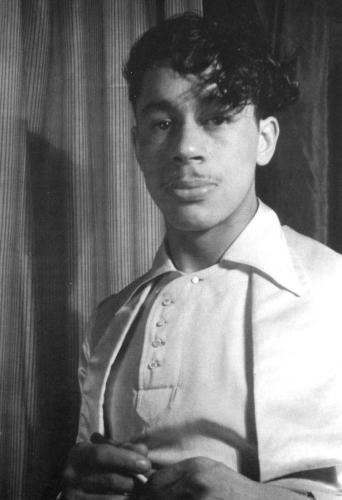
A young Cab Calloway.
Cab Calloway was born on Christmas Day in 1907. Initially he lived in Rochester, New York, but not long after his father passed away and his mother remarried, Calloway found himself spending his childhood in Baltimore, Maryland. As a young boy, Calloway enjoyed being around horses and horse racing tracks. Being from Baltimore, he spent as much time as he could at Pimlico Race Track (home of The Preakness Stakes, part of horse racing's Triple Crown of races). Betting on the ponies was something that was to become a lifelong obsession. In fact, it was an incident as a teenager that involved gambling near a church that caused Calloway to spend time at a reform school for wayward youth. The time he spent there certainly captured his attention. Calloway emerged back into society determined to make a name for himself. While his mother desperately wanted him to study law, Calloway had his heart set on music. Following in the footsteps of his older sister Blanche, who had already entered the world of Jazz, Calloway began taking formal singing lessons. As he entered his twenties, Calloway traveled to Chicago and began singing in clubs there. While in Chicago, Calloway met fellow singer and established star, Adelaide Hall. He also met trumpeter Louis Armstrong. His meeting up with Armstrong was fortuitous because it was through Armstrong that Cab Calloway learned skat singing. As you may know, skat singing is a style of singing in which nonsense syllables and other sounds are substituted for actual song lyrics. These nonsense sounds act in concert with the notes emanating from the instruments being used by the orchestra, which has the effect of turning the human voice into a musical instrument. Cab Calloway honed his skill as a skat singer and took his talent to New York City, where he entered the world of the Harlem Renaissance that was already in full swing.

Exterior of the Cotton Club nightclub, New York, (Photo by Michael Ochs Archives/Getty Images)
When Calloway landed in New York City, he quickly fell in with other musicians who had begun to establish themselves in the city, such as Duke Ellington and Fats Waller. All of these musicians played at rent parties and started earning a reputation as quality players. Cab Calloway, in particular, started becoming known for his singing skills and his charming personality. As he began to become a regular fixture on the rent party circuit, he was approached by the owners of the world famous Cotton Club to act as a fill-in performer during those times when regular house band leader, Duke Ellington, was away on tour with his orchestra. Calloway agreed. As part of his gig as band leader at The Cotton Club, Cab Calloway started appearing on national syndicated radio with the likes of Bing Crosby, thus making Calloway the very first person of colour to have his own national radio show. By the time the Great Depression began to be felt across North America, Cab Calloway was making over $50,000 a year, which was a princely sum at the time.
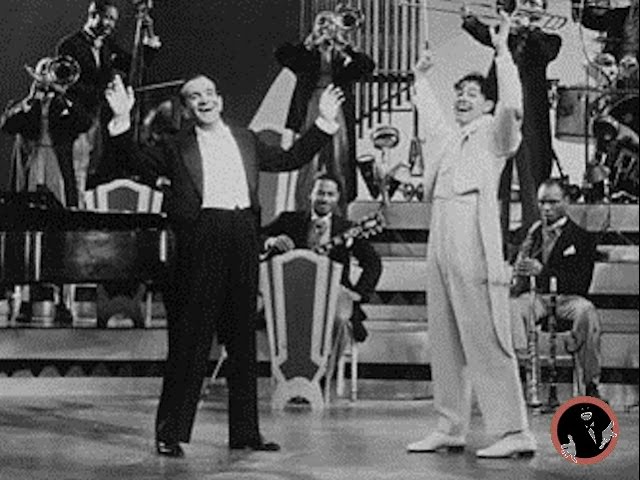
Al Jolson and Cab Calloway in The Singing Kid.
Cab Calloway met many interesting people during his time at The Cotton Club. He used the personalities of these people as the inspiration for a series of original songs. In 1931, he released a song called "Minnie the Moocher" that was based upon a Cotton Club regular who was forever thirsty but never seemed to have any money to pay for her drinks. This song features a very famous bit of call-and-response skat singing that involves the word segments "Hi De Hi". The popularity of the "Hi di hi, hi de ho" chorus swept the country, taking "Minnie the Moocher" all the way to the top of the charts. Cab Calloway sold over one million copies of this song, making him the first person of colour to achieve such a milestone. The success of "Minnie the Moocher" allowed Calloway to cross over into the world of film. He sang that song, along with two others, as part of the Betty Boop cartoon series. The success of Betty Boop cartoons drew the attention of Hollywood studio executives. As the 1930s moved along, Cab Calloway was featured in several short films, many of which featured the singing of the "Hi de hi, Hi de ho" chorus. In 1935, he helped introduce a young singer named Lena Horne to the world via one of his short films. As the decade drew to a close, he appeared on screen with white singer Al Jolson. When they shared the screen together while singing duets, it marked one of the very first times that people of different races appeared as equals together on screen at the same time. That movie was called The Singing Kid and is credited with helping to break down racial barriers in Hollywood and around the world. As if that wasn't enough, in many of his 1930s films, Cab Calloway can be seen doing a dance move called "the Backward Glide". It was this move that many think Michael Jackson was emulating a half century later when he electrified the world by introducing the "Moonwalk" dance move.

As the 1940s began, Cab Calloway was now becoming known as one of the most popular entertainers in America. The beginning of this decade saw Cab Calloway do two separate things that ensured that his impact as a person and as a role model would be long lasting. First of all, Calloway created his own dictionary. That may seem like an unusual thing for a Jazz musician to spend time doing, but there is more to this than first meets the eye. There are many things that act to define a culture. There is music and storytelling and poetry and art and fashion, and there are larger-than-life personalities all involved, but one of the things that ties this all together is language. One of the things that usually happens when one dominant culture attempts to control/colonize another through cultural assimilation (as seen in what happened to the Indigenous peoples of North America) is that cultural traditions and language usage are taken away. The colonized peoples are forced to adopt the language, traditions and history of the conquerors. In time, as generations go by, the hope of the colonizer is that the conquered peoples will forget their past ways and become assimilated into the dominant culture. When that happens, subjugated cultures disappear and cease to exist. Without going into a great, long history lesson, one of the abhorrent aspects of slavery was a similar denial of culture and history for people of colour in America. Part of the reason that the Harlem Renaissance came into being in the first place was to help re-establish that sense of cultural identity for people of colour. Part of that process of cultural reappropriation came in the form of art and music and theatre and literature. As those scenes began to become established as new and thriving parts of life in America, Cab Calloway and others felt the time was right to take back control of language, too. This move to formally enshrine cultural language was not meant to create a threat to established North American language conventions; it was simply meant to allow people of colour to express themselves and their feelings and ideas in their own culturally-specific words. Consequently, in 1938, Cab Calloway compiled and published his dictionary that was entitled Cab Calloway's Cat-ologue: A Hepster's Dictionary. The vernacular that Calloway captured in his dictionary was the language of Jazz clubs and of Harlem, in general. In the larger society, the language denoted in the Hepster's Dictionary became known as Jive. As was noted by poet Lemn Sissay, "Cab Calloway was taking ownership of a language for a people who, just a few generations before, had their own languages taken away". As much as Cab Calloway is known for his contributions to the world of Jazz music, his efforts to codify the language of those sharing his cultural world should not be underestimated. It was no small feat to do what Calloway did by using his fame to uplift an entire race of people.

The Nicholas Brothers.
Further to that, in 1943 Cab Calloway agreed to take part in a landmark film called Stormy Weather. This film starred Calloway, along with Lena Horne, Bill "Mr. BoJangles" Robinson, Fats Waller, Dooley Wilson and the Nicholas Brothers, among others. Stormy Weather was one of the first movies to feature an all-black cast in the lead roles. The premise of the movie was a love story that was told via a series of musical vignettes. For many, the highlight of the film appeared toward the end when Cab Calloway teamed up with the Nicholas Brothers to perform a song of Calloway's called "Jumpin' Jive". In the film clip that I will link to below, Calloway sings and dances for the first half of the clip and then turns the stage over to the Nicholas Brothers. The Nicholas Brothers were two brothers named Harold and Fayard. There are many who state that the Nicholas Brothers were the pre-eminent tap dancers in America at the time that Stormy Weather was filmed. No less an authority than Fred Astaire stated that the dance sequence for "Jumpin' Jive" is the single best dance sequence ever filmed in cinematic history! What makes this dance sequence so much more impressive than it first appears is knowing that the entire scene was shot in one single take and that there had been no rehearsals prior to filming. What was captured on tape was the one and only time Harold and Fayard did that dance. When you watch the film, you will see why. To say that they dance with style and with reckless abandon in equal measure is not an understatement. The entire scene is simply one spectacular feat of athleticism and death-defying skill after another. As much as Fred Astaire, Gene Kelly and Donald O' Connor are held up as examples of what the best of dance looks like, I cannot say with any confidence that they outshine what the Nicholas Brothers accomplished in Stormy Weather. Simply astonishing!
As the decades rolled by, Cab Calloway continued to make music and to act on stage in musicals and in movies. Along with his daughters Lael and Chris, Cab Calloway recorded new music and appeared on The Ed Sullivan Show in the 1960s. He also appeared in the all-black cast of Hello, Dolly! after Carol Channing had finished her run. Then, all the way in 1980, Calloway came full circle. He was cast as himself in the movie The Blues Brothers starring John Belushi and Dan Aykroyd. In that movie, he got to sing "Minnie the Moocher" again and introduce an entirely new generation into the call-and-response chorus of "Hi de hi/hi de ho".
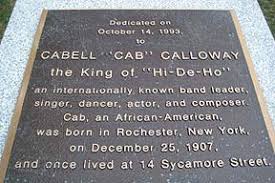
Memorial plaque for Cab Calloway somewhere in Rochester, NY.
Cab Calloway died in 1994 at the age of 87. His legacy is one of immense influence. There are many who state that the great showmanship of performers such as James Brown and Michael Jackson was inspired directly from Cab Calloway. In the Stormy Weather film clip, it is easy to see why people would say that. He certainly had a tremendous stage presence! There are many who also say that his skat singing style, of which he was the best, is what led directly to the style of singing that appears in Hip Hop. As you may know, the pairing of vocal utterances and beats in Hip Hop mirrors what Calloway did when he used skat singing to complement the notes played by his orchestra members. Whether you agree with this comparison or not, what is true beyond any doubt is that Cab Calloway enjoyed a career that easily ranks him among the greatest Jazz musicians and entertainers of all time. What is also true is that he is owed a great debt of gratitude for his efforts to enshrine the legitimacy of an entire race of people through his actions in creating his own dictionary, of willingly appearing on screen with white actors at a time when the mixing of the races just wasn't done and finally, lending his credibility to projects such as Stormy Weather that gave other performers of colour the chance to shine on the biggest of stages under the brightest of lights. Hopefully, when I get to visit Rochester, New York, this summer, I will be able to find the monument there that pays tribute to him as his birthplace. In the meantime, I will simply re-watch the "Jumpin' Jive" clip, slack-jawed as I tend to be, over and over again on repeat. "Hi de hi/ hi de ho" to you, Mr. Cab Calloway. Thanks for all that you did to help make life better. May you rest in peace now and forever more.
The link to the official website for Cab Calloway can be found here.
The link to the video for the song "Jumpin' Jive" by Cab Calloway from the film Stormy Weather, featuring the absolutely incredible dancing of The Nicholas Brothers can be found here.
The link to the video for the song "Minnie the Moocher" as shown in the film The Blues Brothers can be found here.
The link to the official website for the city of Rochester, New York can be found here.
***As always, all original content contained within this post remains the sole property of the author. No portion of this post shall be reblogged, copied or shared in any manner without the express written permission of the author. ©2024 http://www.tommacinneswriter.com


No comments:
Post a Comment