

There are moments when you read the Torah and suddenly realize that what looked like religious ritual is actually political theory. Parshat Bamidbar is one of those moments. At first glance, the opening chapters of the Book of Numbers seem painfully bureaucratic: census records, tribal lists, camp arrangements, military counts, banners, and marching orders. It reads less like revelation and more like paperwork. But what if the Book of Numbers is not really about numbers? What if the census in the wilderness was actually the birth of the first constitutional government? This week I encountered the work of Daniel Elazar, one of the great scholars of federalism and Jewish political thought, and suddenly Bamidbar looked completely different. Elazar was not simply a Bible scholar with an interest in politics. He was one of the twentieth century’s leading theorists of federalism, a professor at both Bar-Ilan University and Temple University, founder of the Jerusalem Center for Public Affairs, and author of more than sixty books on political culture, covenant, and constitutional design. In 1986, he was appointed by Ronald Reagan to the U.S. Advisory Commission on Intergovernmental Relations, the federal body tasked with studying relations between states and the national government. Remarkably, he also conducted a major multigenerational study on the development of civil community in Midwestern American cities — because for Elazar, federalism was never merely theoretical. It was about how human beings actually learn to live together while remaining different. According to Elazar, the Israelite tribal federation described in the Bible may have been one of the first great federal experiments in human history — long before the Federalist Papers, the United States Constitution, or modern democracy. In Exploring Federalism, he writes:
And once you see it, you cannot unsee it. The Torah is not counting individuals. It is organizing tribes. The politics of the wildernessThe opening verses already hint at something deeper:
Look at the social architecture embedded in those verses:
This is not a random census. It is a political map. Every tribe has:
Even the physical layout of the camp is constitutional:
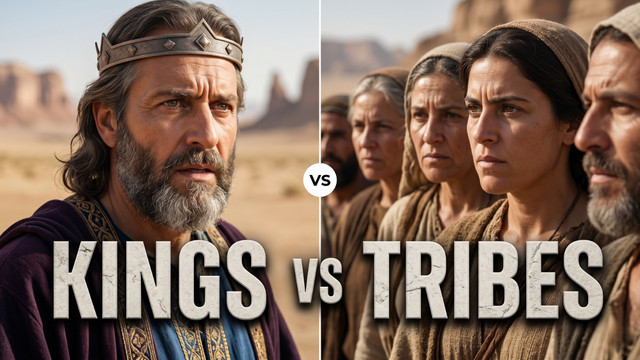
We typically imagine Sinai as 600,000 isolated individuals gathered around a mountain. Elazar helps us see something else entirely. We begin to see twelve tribes — each with its own flag, leader, formation, and identity — arranged around a shared sacred center. Not a mass of individuals. A tribal confederacy. Difference is not erased. It is organized. For Elazar, this was revolutionary. In Exploring Federalism, he writes:
That wonderfully disarming phrase actually captures one of the deepest tensions in political life. How do you create a shared society without erasing local identity? How do tribes become a nation without ceasing to be tribes? For Elazar, Bamidbar represents one of humanity’s boldest attempts to solve that problem. The wilderness camp becomes a political vision: Before “We the People”Elazar makes another astonishing claim:
And then:
This was radically different from the political structures surrounding ancient Israel. Egypt represented what Elazar calls the “power pyramid”: But Elazar contrasts this not only with Israel, but with another great model of political organization: the organic polis of the ancient Greeks. Greek political thought, which later gave birth to Natural Law theory, imagined society growing organically out of nature, kinship, and civic life. Politics emerged naturally, almost biologically, from the structure of the city-state itself. Israel proposed something radically different. Neither conquest nor organic evolution. Covenant. Elazar writes that political science has traditionally understood three ways that polities come into existence:
And that distinction changes everything. Because before Sinai, Israel was merely a loose kinship society held together by custom and shared ancestry. But at Sinai, according to Elazar, there is a constitutional revolution. As he writes:
That is an astonishing statement. Sinai was not merely the giving of laws. It was a paradigm shift in political consciousness. A collection of tribes became a covenantal polity. Before Sinai: After Sinai: Or as Elazar famously defined federalism:
Suddenly the Book of Numbers begins to sound less like bookkeeping and more like constitutional design. Genesis was preparing the federationOne of Elazar’s most fascinating insights is that the Torah had been preparing for this constitutional moment from the very beginning. The stories of Abraham, Isaac, Jacob, Joseph, Leah, Rachel, Bilhah, and Zilpah are not merely family drama. They are political prehistory. Elazar writes:
And then:
This completely changes how we read Genesis. Sibling rivalries become political negotiations. Joseph’s rise to power becomes tribal diplomacy. The shifting status of Ephraim, Manasseh, Levi, and Judah becomes constitutional evolution. The Book of Genesis was laying the narrative groundwork for a federation long before the tribes assembled around Sinai. And then Bamidbar becomes the operational manual for making that federation work. Elazar calls Numbers part of the Torah’s “constitutional corpus” and writes:
He then maps the entire Book of Numbers as a handbook for federal governance:
Suddenly Bamidbar no longer reads like wilderness bureaucracy. It reads like constitutional infrastructure. The Torah is not merely forming a religion. It is building a polity. The tribes were never fixedOne of the most fascinating details in Bamidbar is that the “12 tribes” are never actually fixed. Sometimes Levi disappears. The point was never ethnic purity. The point was the federation. The structure mattered more than rigid genealogy. The Torah seems less interested in creating homogeneity than in creating a durable framework where differences can coexist inside a covenantal order. Judaism kept thinking like a federationBut here is the insight from Elazar that struck me most deeply. The tribal federation eventually disappeared politically. The monarchy arose. And yet, Elazar argues, the Jewish people never stopped thinking like federalists. Listen carefully to this extraordinary line:
That may explain something profound about Jewish intellectual life itself. Judaism has always been remarkably unified and deeply argumentative at the same time. One Torah. One covenant. One people. The Talmud preserves minority opinions. Perhaps this was not an accident of history. Perhaps Judaism inherited a federalist cast of mind from the wilderness itself. A political culture that understood: An alternative to homogenized universalismBut Elazar goes even further. Most modern universalist visions imagine that peace comes when differences disappear. Borders soften. But the Bible imagines something very different. Elazar notes that even the prophetic vision of the end of days preserves tribal and national distinctions. He writes:
This is an astonishing idea.
Even in the Messianic age, The tribes remain tribes. The nations remain nations. Unity emerges not from homogenization, This is not tribalism in the destructive modern sense. It is something closer to enlightened particularism: That may be one of the Torah’s most radical political insights. The politics of differenceModern politics often swings between two extremes: Either every group retreats into itself, Bamidbar proposes another possibility. The camp in the wilderness had many banners, Many tribes, Many voices, Maybe that is why this ancient book still feels strangely contemporary. Because somewhere between the wilderness camp and modern democracy lies the same enduring question: How do separate tribes become one nation without ceasing to be themselves? Sefaria Source Sheet: https://voices.sefaria.org/sheets/725075 Listen on Spotify:
|





No comments:
Post a Comment