
How I Learned To Fear The PianoAnd how I found my way back to it, after years of believing I wasn't good enough.
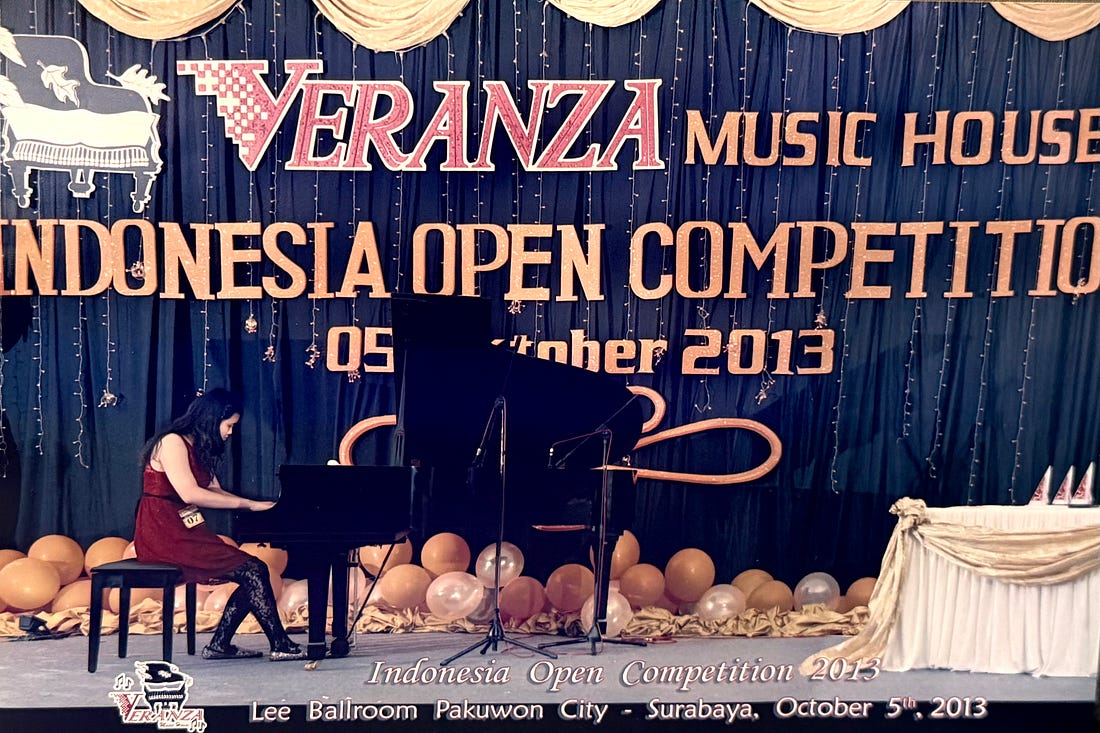
Ever since my mother enrolled me in piano lessons as a child, I’ve always carried a deep love for the instrument. There was something magical about watching my older cousins play, attending their recitals and listening to pieces that seemed impossibly difficult to play, yet effortlessly beautiful. I dreamed of standing on a stage like that one day, performing music with the same confidence and grace. More than anything, I wanted the elegance that seemed to come with knowing how to play the piano. But my journey with music was far from idyllic. Unlike my sister or my older cousins, I wasn’t naturally gifted. If a piece took them a week to learn, it might take me two or three. Every performance demanded hours of repetition, experimentation and frustration. I couldn’t rely on talent alone (or my lack thereof), so I had to invent my own methods through trial and error. I learned how I learned—finding techniques that suited my hands, my memory and the way my mind processed music. Looking back, I realize I wasn’t actually less capable. I simply had to become more resourceful much earlier. And here’s the difficult truth about the world of classical music: it rarely rewards effort as generously as it celebrates talent. Which is why, most of my piano memories are often tangled up with comparison. I was constantly measured against my cousins, friends or anyone around my age who seemed to progress faster than I did. Before every recital, every competitions, the voices of those criticisms would begin long before I touched the first key. They would swirl around in my head until they drowned out everything else, and by the time I started playing, my whole body would tense and my hands would already be trembling. It didn’t help that I rarely found teachers who understood me. Many of them naturally gravitated toward the students who learned quickly, and I can’t blame them, really. Teachers often have limited time, and gifted students are easier to polish. But as a child, it felt as though I had become invisible. The slower I learned, the less attention I received, and the less attention I received, the more convinced I became that I simply wasn’t good enough. Because of this, little by little, my love for the piano began to fade. I did graduate eventually. Barely. Yet I’m proud of myself that I finished it, especially considering how much of the journey I spent doubting whether I belonged there at all. I even managed to win a local piano competition as my own ‘final act’, before walking away from that chapter of my life completely. At least, that’s what I thought I was doing. I thought I could get over it and move on. Pursue something that’s worth pursuing. Something of my own, my real talent. But throughout my university days, I still couldn’t stop thinking about piano. There was an emptiness I couldn’t quite explain, a lingering dissatisfying feeling that my music education had ended before it truly began. I never felt challenged in the way I had hoped to be. I never learned the proper techniques required for the repertoire I had always dreamed of having. I never get to learn the sweeping emotion of Rachmaninoff, the dramatic intensity of Beethoven’s Pathétique, the kind of pieces that demanded not just technical ability, but emotional maturity. It felt like I had only skimmed the surface of what music could become. While many of my friends happily closed the lid on the piano after finishing their graduating exams, I found myself being pulled back to it over and over again.
Whenever I had the chance, I’d wanter into the arts building on my campus, quietly slipping into an empty practice room whenever I could. I’d head into the classroom with the Steinway (thanks to my best friend who had classes there). I’d sit there for as long as I was permitted, playing whatever came to mind until the security guard eventually asked me to leave. Sometimes, perhaps sensing how much those moments meant to me, he’d smile and let me stay until the building closed. Looking back, I don’t think I could ever truly quit piano. I simply walked away after I graduated, from the version of piano that had taught me to associate music with fear. Now, years later, after enough healing to quiet those old voices, I’ve decided to return by pursuing a Diploma degree. Not because I have something to prove, but because somewhere beneath all that anxiety, there was still this little girl who fell in love with the piano before anyone convinced her she wasn’t good enough. And I believe she deserves another chance. This taught me an important life lesson.There are dreams we abandon not because we stop loving them, but because someone, somewhere along the way, convinced us that we weren’t talented enough, smart enough or worthy enough to keep going. Sometimes we don’t give up on the dream, we simply give up on the version of ourselves that believed we could achieve it. So if there’s something you’ve been avoiding because it reminds you of failure, comparison or heartbreak, maybe it’s worth returning to. Not immediately. Not without first giving yourself the time to heal. But when you’re ready, try again. Because sometimes the very thing you’ve been running from isn’t what hurt you in the first place. It’s the shame attached to it. And once you’ve untangled the two, you may discover that the thing you loved all along was never your enemy. It might even become the thing that helps you heal your inner child. Sincerely, Cherie. The Whiffler is free today. But if you enjoyed this post, you can tell The Whiffler that their writing is valuable by pledging a future subscription. You won't be charged unless they enable payments.
|





No comments:
Post a Comment