
The Budget Knew Before the “Emergency”RIOC anticipated a $7 million Steam Plant demolition for 2015. Nine years later, New York City used emergency authority to carry it out.
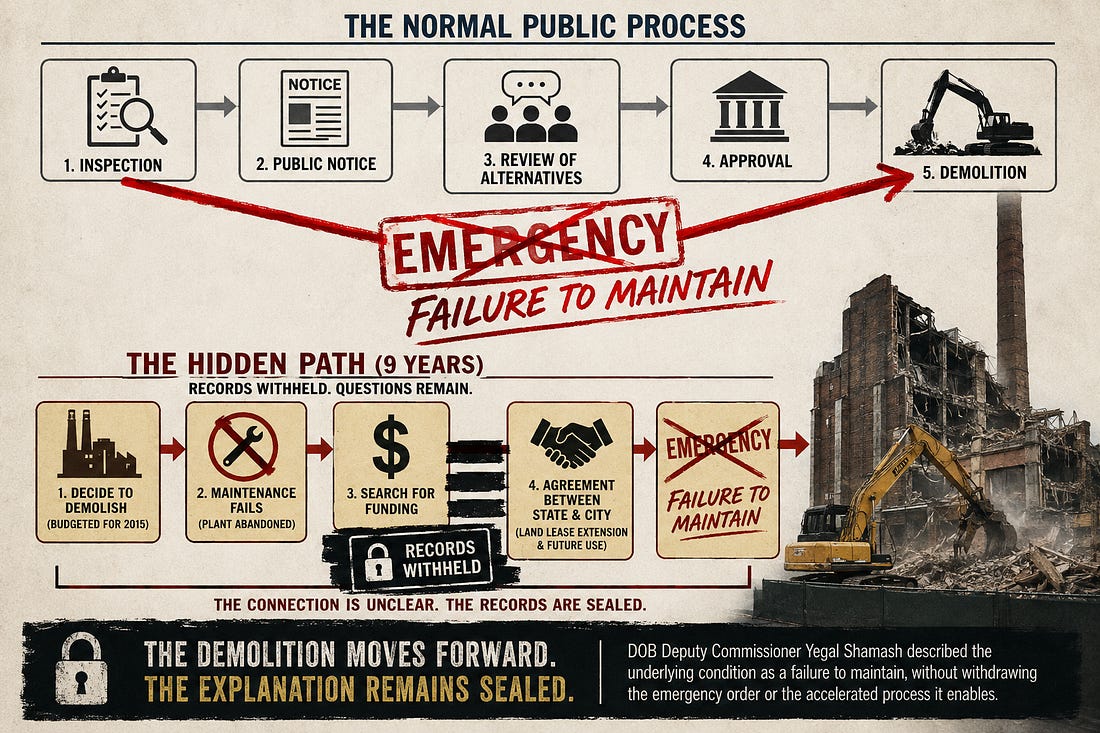
The Demolition Budgeted for 2015The demolition began on paper long before the City invoked emergency authority to carry it out. In RIOC’s fiscal 2013-14 budget, the Corporation set aside $7 million for fiscal 2015 for the complete demolition and cleanup of the Roosevelt Island Steam Plant. RIOC called that figure its worst-case scenario, meaning the State corporation might be left responsible for the entire cost. That entry changes the starting point of the current story. The public has been asked to understand the Steam Plant demolition as the response to a July 2024 emergency order issued after the Department of Buildings identified deteriorating masonry, visible cracks and dangerous conditions at the building and smokestacks. What the budget establishes is that demolition was already a foreseeable public obligation more than a decade earlier. The question is therefore not whether officials could have predicted that an unused industrial building would eventually require a decision. They did predict it. They gave the prediction a price and a year. The unanswered question is what happened after the prediction became inconvenient.
Abandoned TwiceThe plant was first abandoned as a working system. In 2014, the New York City Health and Hospitals Corporation informed RIOC that the Steam Plant had been decommissioned and would no longer provide steam heat. The plant had served the island’s hospitals and at least one RIOC facility, Sportspark, where a temporary boiler was installed to replace the lost steam service. RIOC’s budgets then began carrying the smaller, recurring costs of a shutdown whose larger consequences were left unresolved. The larger obligation did not follow the same path. In the next budget, the clear $7 million demolition line gave way to a revenue entry labeled “Steam Plant Redevelopment,” with no projection because negotiations remained unresolved. Demolition had not been completed. Redevelopment had not been defined. The public record had moved from a priced obligation to an unpriced possibility. That was the second abandonment. The building remained physically present, but responsibility for its future stayed suspended between governments. The City had operated the plant. RIOC controlled much of the surrounding Island. Each could point to the other’s role while time continued performing the one task no agency had funded: deterioration. The “Emergency” Arrives on ScheduleBy July 2024, the Steam Plant had acquired a new designation: an “emergency.” The timing is notable. As the State and City were negotiating the future of Roosevelt Island, including the lease and redevelopment of this part of the Island, the long-neglected Steam Plant suddenly received sustained official attention. DOB issued an emergency order, and the City later placed HPD’s Demolition Unit in charge of removing the structure. By June 2026, HPD had begun demolition work, air monitoring and environmental procedures under a formal project process that had been absent throughout the preceding decade. But DOB’s later explanation drew a narrower line around what had occurred. Deputy Commissioner Yegal Shamash described the underlying condition as a failure to maintain and identified securing the dangerous perimeter as the immediate emergency response. That did not withdraw the order. It did, however, leave an important question unanswered: how did the urgent need to protect the public become authority for the complete demolition of a structure government had already contemplated removing more than a decade earlier? The plant obtained what it had lacked for years: an agency with authority, an action and a procurement path. Emergency powers allowed that machinery to move without the public process that might have examined stabilization, demolition scope and alternatives before the outcome was settled. The strange part is not that government acted. It is that the same broad outcome RIOC budgeted for 2015 returned nine years later under emergency authority, while DOB later described the underlying failure in considerably less sudden terms. The demolition continues at emergency speed, bypassing the ordinary public process, while the records explaining the nature of the “emergency” and how it came into being remain sealed from public view.
What the Budget ProvesWhat is clear is that demolition was not a sudden idea. RIOC identified the plant for removal nine years earlier as part of clearing the site for future redevelopment. The Governor’s later announcement also makes clear that the State and City reached an agreement tied to extending the island’s land lease and planning the property’s next use. What remains unexplained is what happened between those points, who made the decisive commitments and when the demolition outcome became fixed. The unanswered question is the “emergency.” DOB Deputy Commissioner Yegal Shamash publicly described the underlying condition more narrowly as a failure to maintain, without withdrawing the emergency order or the accelerated process it enabled. Demolition now proceeds under emergency authority, outside the ordinary public review that might test its scope and necessity, while the records showing how that emergency was defined, justified and connected to the State and City’s broader plans remain undisclosed. More than six months ago, we began filing FOIL requests seeking the records that might explain how this “emergency” was born. Substantive responses have not arrived. DOB has since produced a structural assessment dated 2026, not the contemporaneous engineering record that would explain the 2024 authorization. We are not prepared to jump ahead of the documents. But the public record already contains a decade of demolition plans, State-City negotiations and a governor’s announcement describing the site’s future after demolition. What remains missing is the record connecting those plans to the emergency authority used to carry them out. A reader might conclude that the emergency was manufactured or later justified retroactively. We are not making either claim without the records. What can be said is that the documents needed to test those possibilities remain undisclosed. This newsletter travels best hand to hand. If you know someone who would read this all the way through, they are probably who it is for. Subscribe for free to receive updates on new posts and support our work.
|






No comments:
Post a Comment