
Three Newspapers and a Broken Water FountainOne paper stopped arriving. Another outgrew the list that started it, then learned how to say goodbye.
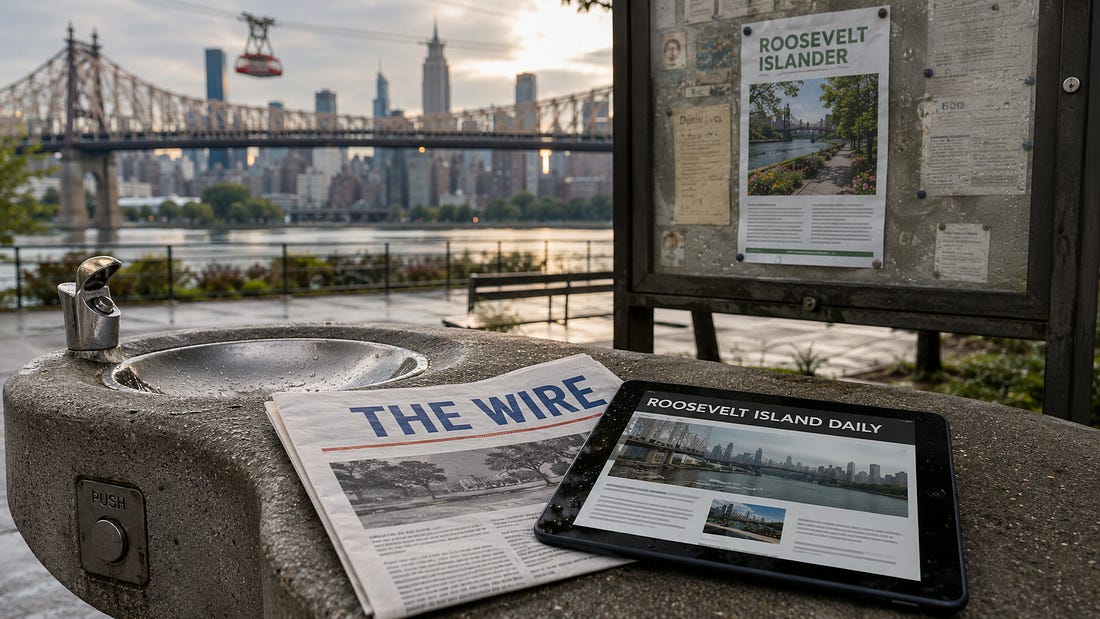
In 2018, Roosevelt Island had three local newspapers and no working drinking fountains. Seven years later, one paper had disappeared, one founder was leaving the country and the word “your” was about to receive a much clearer ending. When the Journalism Was FlowingIn September 2018, the Columbia Journalism Review came to Roosevelt Island and found a headline so perfectly arranged that it sounded fictional: “Roosevelt Island has three news outlets, but no working water fountains.” The headline referred to the Main Street WIRE, the Roosevelt Islander and the Roosevelt Island Daily. Roosevelt Island had three publications for roughly 12,000 residents. That sounds excessive until RIOC begins explaining something. The WIRE arrived in print every two weeks. Rick O’Conor operated the Islander with the restless efficiency of a man who could turn a comment beneath one story into the next story. David Stone had started the Daily in 2016 after his proposed succession at the WIRE collapsed. The WIRE printed the news, Rick posted it and David delivered it with enough heat to eliminate the need for a second water test. They did not share a format, temperament or opinion of one another. They did, however, share an Island where even the drinking water had developed a communications strategy. The singular fountain in my title is a convenience. RIOC had shut down outdoor drinking fountains across its parks and playgrounds after questions arose about possible contamination. Ten fountains and a splash area were tested. Two fountains at Capobianco Field, directly across from PS/IS 217, later produced abnormal bacterial counts associated with low chlorine, although no coliform or E. coli was found. The journalism was flowing more reliably than the water, which was not an especially high standard, but it was ours. The fountains went out together. The piers later developed structural problems together. Roosevelt Island infrastructure does not deteriorate; it networks.
What interests me now is not only the absurdity of that moment. It is the picture CJR preserved. Three small publications were watching the same narrow strip of land from different windows. When water was cut off at the Wildlife Freedom Foundation’s cat sanctuary and the fountain questions followed, each publication pursued the story. Their combined attention did not repair the plumbing, but it made the failure considerably harder to bury. That is one of the values local journalism offers that cannot be measured by circulation alone. A broken fountain may appear to be a maintenance complaint. Three reporters looking at it can reveal a water system, a public agency and a long history of decisions made without expecting anyone to check the connections. The Paper That Stopped ArrivingFor years, the WIRE felt less like a publication than part of the Island’s weather. It appeared at apartment doors and in building lobbies, folded into a shape that made the important story compete with whatever advertisement had landed on the reverse side. Residents carried it into elevators, left it on benches and argued over letters written by neighbors they would probably encounter before dinner. Online news is faster, but it meets each reader alone. The WIRE was something the Island opened together. Sometimes we even read it before checking whether our names were in it. I do not remember a final issue arriving with the dignity we assign to endings after we know they are endings. The WIRE continued beyond the 2016 transition, under Briana Warsing’s leadership, and remained one of the three publications profiled in 2018. By 2019, it was still covering Island events. Then its presence thinned. Printing, mailing and distribution cost money. Online competitors published before ink could dry, assuming anyone still had ink. By April 2021, the agenda for a Community Board 8 Roosevelt Island Committee meeting included a revealing item: “Resurrect the WIRE initiative to bring back our local paper.” No obituary had appeared. Instead, the newspaper’s death arrived disguised as a committee agenda item. Roosevelt Island institutions rarely receive funerals. They receive working groups, the Island’s preferred form of grief. Nobody cries, but everyone agrees to circle back. Its gradual disappearance also left the archive problem Stone had anticipated in 2016. He had proposed storing the historical issues, finding them a permanent home and making the digital collection searchable. That plan vanished with the succession. The paper stopped arriving, but decades of Island memory did not suddenly become less important because nobody had budgeted to preserve it.
The Daily Wins the ClockThe Daily did not defeat the WIRE by becoming a better printed newspaper. It prevailed because it did not need to be one. Stone could publish when an elevator stopped, a meeting ended or RIOC produced an explanation that explained everything except what had happened. The Daily belonged to the clock local news was becoming. Its deadline was whenever Stone stopped typing, which occasionally appeared to be never. For nearly nine years, he reported on public meetings, Island personalities, neglected infrastructure and the internal behavior of RIOC. His style could be severe, personal and openly impatient. Readers did not need to agree with him to recognize the function he performed. The Daily made silence newsworthy, which was unfortunate for an agency that produced so much of it. Eventually, “daily” began describing an obligation more than a publication. Stone stopped regular operations on January 31, 2025, and prepared to leave Roosevelt Island. Theo Gobblevelt called it the end of an era, although the ending proved less final than it appeared. Stone left the Island and later the country. After a break, he returned on his own schedule through The Umwelt Gazette. Roosevelt Island had apparently retained forwarding privileges. Geography accomplished what RIOC never could: it slowed him down slightly. Four Thousand Articles and One Useful WordBefore leaving, Stone had to decide what would happen to the Daily. The March 2025 correspondence is striking for its lack of drama. The WordPress subscription had been paid, and the website contained roughly 4,000 articles. Stone asked how to transfer control. Theo supplied the instructions. Stone completed the first step and replied:
When the ownership transfer followed, Stone wrote again: “Done. Good luck with it!” I laughed when I first read that exchange, partly because history had developed timing. In 2016, Dick Lutz sent Stone a mailing file described as “your list,” two words that later carried enough disagreement to reach New York Supreme Court. In 2025, Stone transferred the Daily to Theo using the actual language of ownership and confirmed when the work was finished. No one had to determine which meaning of “your” applied. WordPress had already supplied a permissions menu. The audience handed forward was also substantially larger than the one Stone had received nearly nine years earlier, roughly twice the size by the time of the transfer. He had taken a dormant collection of addresses, built an independent publication around it and eventually passed along the expanded readership with the site. The mailing list that once divided two newspapers had become part of the infrastructure keeping another one alive. There is a quiet generosity in that decision. Stone could have shut down the website and allowed its thousands of articles to disappear behind an expired subscription. Instead, he transferred the publication, its archive and its audience while the machinery still worked. He even identified when the plugin subscriptions would expire. Eight years older and several arguments wiser, Stone understood that a successful handoff should end with “good luck,” not discovery. What the Island Carries ForwardThe WIRE did not receive the succession Stone once planned for it. Its printed archive remains scattered, its disappearance difficult to place on a single date. Yet a future imagined during that failed transition survived in another form. The Daily’s articles remained online, searchable and capable of being carried forward by others. Rick O’Conor continues publishing the Roosevelt Islander. Theo assumed responsibility for the Daily. The Lighthouse emerged with a different rhythm and purpose. Stone writes again from abroad when he has something to say, The names and formats changed, but Roosevelt Island continued producing more local journalism than many neighborhoods with working fountains and fewer lawsuits. I used to think the survival of a newspaper depended on writing. The older I become, the more I suspect it depends on unromantic things: passwords, subscription renewals, storage, mailing systems and someone willing to assume responsibility before the previous person disappears. Journalism may concern great truths, but its existence often rests on remembering which email address owns WordPress. The first handoff left an unfinished argument over “your list.” The second left an archive, a larger audience and four unambiguous words: “Done. Good luck with it!” On Roosevelt Island, that qualifies as a complete succession plan and possibly an infrastructure improvement. This newsletter travels best hand to hand. If you know someone who would read this all the way through, they are probably who it is for. Subscribe for free to receive updates on new posts and support our work.
|






No comments:
Post a Comment