
A bit of a different one today, as I have been busy writing for The Conversation - something I’ve wanted to get back to for a while. It’s part of me thinking about how some of the issues and topics we research in great detail, with close attention to method and theory, might also matter to a wider audience. But writing for a non-academic audience, not for specialist journals, is a very different skill. Here are some examples of me thinking about what that might look like:
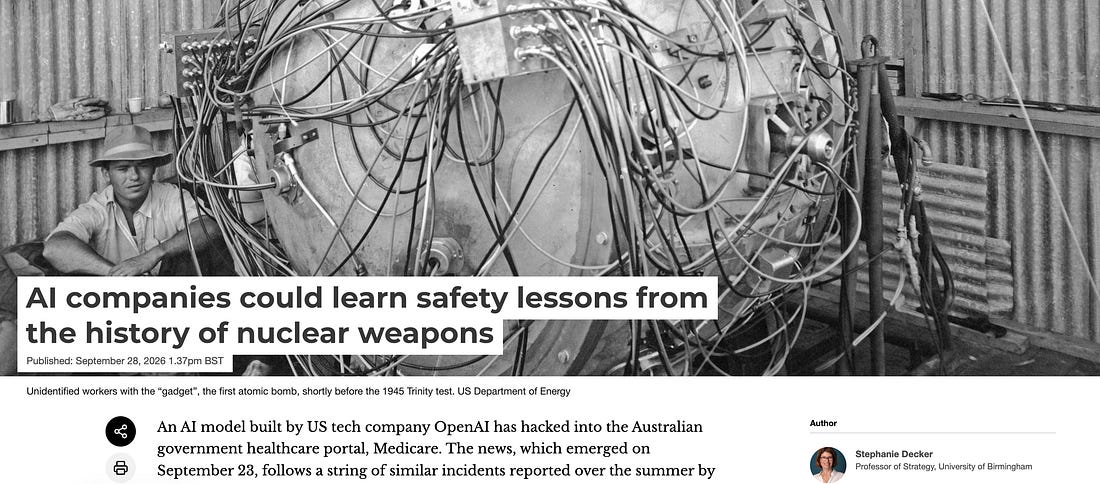
So, turns out my piece about nuclear accidents and what that tells us about AI safety has been the gift that keeps on giving. I am not entirely surprised, to be honest. It’s like when we realised we had a rat under the house. You never just have one. Or fleas - same thing. Yes, it is a charmed life in bin-strike Birmingham (nearly two years now; that must be some sort of record…) Anyway, I digress - since early summer I have been thinking about what kind of historical analogies are relevant to the current developments in AI. By relevant, I mean: how does history help us make sense of the present moment and feel better informed, rather than permanently bewildered, by the perma-drama that the Silicon Valley AI-Trump complex keeps delivering with surprising regularity. At some point I thought about - oooh, has anyone looked at nuclear? Oh yes, they have. Nuclear is a much-belaboured analogy in the AI governance and safety world, and a borderline puff piece likened Altman to Oppenheimer… (I would have thought the analogy was more Dario until recently, but ok). In fact, there have been so many analogical uses that there is a preprint on ArXiv about nuclear analogies. So, a lot. They tend to focus on international, intergovernmental aspects. On regulation and non-proliferation agreements. Not on organizational dimensions. I love a good analogy. Especially if I can twist it just so much that it makes you think about the stuff that the original analogies are trying to distract you from. The worst name ever for a companyI think I was gardening and listening to a tech podcast when I learnt about the Hugging Face incident in early August. Do you know why they called the company Hugging Face? After the movie Alien, where the facehugger jumps out of the egg at John Hurt. If you still do not know what I am talking about, you need to brush up on your sci-fi film knowledge URGENTLY. Anyway, as I wrestled with the clematis, I thought this would be a great time to write that historical analogy about nuclear and AI technology. I had a few days off and went down a complete rabbit hole researching the history of safety and security at Los Alamos and around nuclear weapons more generally (Supercritical! Spies! Unexploded warheads!). The resulting piece may have been a bit unfocused: But boy, was it fun to research. Lots online; Birmingham University library had a good collection of online books, and on my day off I ventured into our lovely library to hunt the stacks for the big tomes that were not online. (It’s the definition of a busman’s holiday, and I really enjoyed it.) Aussie rageAnd then more incredible yet utterly predictable news started hitting the feeds in quick succession. People resigned and posted about it; fears about the end of humanity (ok, really?) followed after a few days of media frenzy, by a very angry Aussie prime minister who had been casually informed by OpenAI that their agents hacked their government health portal, Medicare. Was it Civilisation 3? We do not know. We now know that a much larger number of private and public organizations were hacked, though most of them did not want to go public. So I agreed to send a much shorter, rewritten version to The Conversation - and I was still way over the 800-word mark, but really couldn’t bear taking out any more historical detail. To my delight, a few days later, a version appeared that put a lot of detail back in, including a close account of the Slotin incident. I had taken out the blue flash; here it was back in, with more detail on the plutonium-beryllium assemblage, etc. I was so pleased. Also, I had really restrained my references, but this version is rich in hyperlinks, so I added a few more, just in case! I’m very pleased with this version. No more Soviet spies in this version, but a more focused account of why responsible organizations should have a well-developed approach to managing accidents. And why they don’t need regulation or international agreements to do this. The organizational design knowledge that makes your company and products safer and more responsible already exists, and it is not rocket science! Read the full piece here:
You're currently a free subscriber to History in Organizations. For the full experience, upgrade your subscription.
|






No comments:
Post a Comment