
Newsround: Conference CfPs galore!I’ll be speaking at EHS in-person AI event | CfPs: CHARM November deadline! | EURAM 2027 Qualitative Restudies track | EBHA 2027 | Aston University Public Events
Contents
1. Marketing History in the Age of AI: Understanding the Past, Interpreting the Present, Imagining the FutureConference on Historical Analysis and Research in Marketing (CHARM)
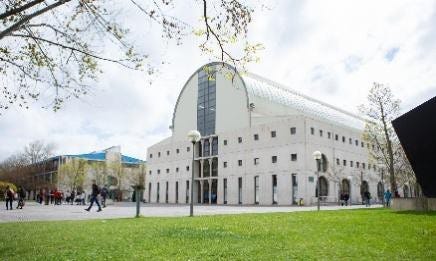
23rd Biennial Conference: May 26 to 29, 2027Host University: Public University of Navarre (Universidad Pública de Navarra/Nafarroako Unibertsitate Publikoa), Pamplona, Spain Submission Deadline: November 15, 2026. Decisions will be made by February 15, 2027. We invite business, marketing, social science, and humanities scholars from all disciplines to join us for a friendly, collegial, and interdisciplinary research conference focused on the history of marketing and advertising. CHARM typically includes likeminded scholars and graduate students from around the globe, who share an interest in historical approaches to markets, marketing practices, advertising, consumption, and marketing thought. Dr. Maria Elena Aramendia-Muneta and Dr. Sara Cano-Rodríguez, our Arrangement Chairs, welcome attendees to UPNA (Universidad Pública de Navarra), a public research university in Pamplona, Spain. The conference will take place at Campus Arrosadia in Pamplona. For detailed information: https://www.unavarra.es/charm or https://charmassociation.org/. To contact the Arrangement Chairs email them at charm2027@unavarra.es
In these challenging times, we call on delegates to explore the insights offered by marketing and advertising history. AI is often framed as a decisive break with the past, yet many of its core concerns: automation, prediction, profiling, targeting, and data-driven decision-making, have longer histories in marketing and advertising. We welcome papers that have a specific focus on the historical development and use of technology in marketing companies, by consumers and in society, along with those that explore marketing history in practice or as theory. However, papers, special sessions, or panels could explore any aspect of marketing history, historic marketing, and the history of marketing thought in all geographic areas and time frames. We encourage historical submissions that discuss methodological, pedagogical and historiographical questions, as well as research on the impact of marketing and advertising in the broader social, cultural, historic, political, and economic environments. Topics may include but are not exclusively restricted to the following:
For information about paper submission, the proceedings, or arrangements please contact the people below:
Program Chair
Co-Proceedings Editors
Arrangement Chairs
FORMAT OF SUBMISSIONSFor questions, or to submit your full paper or extended abstract please email the Program Chair, Dr. Joanne McNeish at: 2027charm@gmail.com. Your submission should include a cover page with the following information:
The cover page must include the following statement: “In the event this submission is accepted for presentation and publication in the CHARM Proceedings, I (or a co-author) intend to present our work at CHARM 2027.” Please use the “Properties” function in Word to remove author information from the document file. All submissions will be double-blind reviewed. Authors of full papers may choose to publish their full paper or create an extended abstract for conference proceedings. Note that submitting a full paper to the Proceedings does not preclude a submission of your paper to a journal. The copyright of a paper published in the CHARM proceedings remains with its authors. Over the years many CHARM conference papers have been published in marketing, historical, sociological and other journals, such as the Journal of Historical Research in Marketing. Authors may choose to submit full papers or extended abstracts:
Note that only full papers are eligible to be considered for the Stanley C. Hollander Best Paper Award (best overall paper) or the David D. Monieson Best Paper Award (best paper by a graduate student). The David D. Monieson Award eligibility requires that the paper be authored solely by a graduate student(s) and that student authorship be noted on the cover page upon submission. Full Paper AbstractThe abstract should be single-spaced and no more than 200 words. Font size is Times New Roman in 12-point. Full papers should begin with a structured abstract as follows:
Extended AbstractExtended abstracts (1,200-1,500 words) should include a one paragraph abstract and the following headings: Purpose and Research Method/Source Material, Preliminary Findings, and Key References. Body and Spacing
Headings Within the Body of the Text
Tables and FiguresTables and figures should be included as part of the manuscript, at the correct location. Use clear titles. Figures should be numbered consecutively, as should tables. ImagesPhotographs and other images should be included in the text at the appropriate location. Please ensure that images are of sufficient quality and size so as to be easily viewed by readers. References
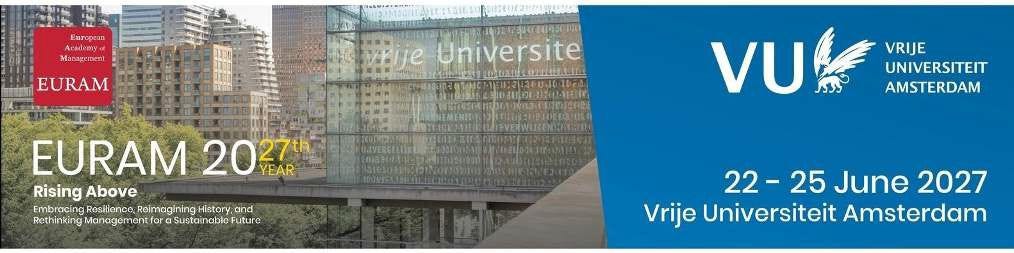
We welcome proposals for specials sessions or panels. Please submit those to the Program Chair, Dr. Joanne McNeish, by July 31, 2026 to 2027charm@gmail.com Decisions on proposals will be made by September 1, 2026. FINAL SUBMISSIONOnce your paper has been accepted and you have made the changes suggested by the reviewers, please submit your revised final paper or extended abstract as a PDF file. Please email it to Tianrong Lu, tlu@ifmparis.fr and Rodica Muravetchi, rmuravetchi@ifmparis.fr by April 30, 2027. Papers/extended abstracts received after this date cannot be guaranteed publication in the Conference Proceedings. Note that for the final submission, the cover page should be removed. The paper title should be printed on the first page of the paper along with author affiliations. The title should be printed in upper case, 14-point Times New Roman font, and centered. Using 12-point font, the author(s) and affiliation(s), email addresses and ORCID identifiers, if available, should be centered, single spaced, with the first author typed on the second line below the title, and then each author below the first. The abstract should follow the last author as part of the first page. By submitting a paper/extended abstract for consideration, if accepted for presentation at the conference, you agree to have it published in the 2027 CHARM Conference Proceedings, hosted by Carleton University Library on an open access platform. The copyright of the work published in the CHARM proceedings remains with its authors. CHARM is permitted to publish the work as part of the conference proceedings, and others will be permitted to download the work and share them with others as long as they credit the author (s), but they can’t change the work in any way, or use the work commercially (Creative Commons License: CC BY- NC-ND). 2. EURAM 2027: SIG 12 - RM&RP - Research Methods and Research PracticeWe invite you to submit your research to explore the theme of RISING ABOVEEmbracing Resilience, Reimagining History, and Rethinking Management for a Sustainable Future for the EURAM 27th Conference. We look forward to receiving your submissions.
Qualitative Restudies: Retheorizing Organizations in a Changing World (T12_ 05)Proponents:
Short description:We invite submissions that are qualitative restudies: empirical studies designed for systematic comparison with the data, findings, and field setting of a prior study. Building on the four restudy designs of Köhler, Rumyantseva, & Welch (2025)—reanalysis, revisit, revision and repurposing—we seek contributions that return to established cases and theories to ask what has changed, and why our earlier conclusions may no longer hold. It speaks directly to the conference theme by treating restudies as a route to more relevant theory and is directly connected to a call for papers in Organization Studies (submission deadline January 31st, 2028). Long description:A restudy is an empirical study designed to enable a systematic and critical comparison with the original data and analytical results of a prior study. By returning to established studies and their original sites, qualitative restudies allow us to examine how interpretation and theorizing are shaped by methodological traditions, historical context, institutional structures and researchers’ backgrounds. Acknowledging the situatedness of inquiry opens the way to more critical and sustained engagement with the phenomena and theoretical legacies on which our field builds (Köhler, Rumyantseva, & Welch, 2025; Rumyantseva & Welch, 2023). The track is organized around four restudy designs that are already used by organization scholars:
We also welcome restudy designs that fall outside this typology, provided authors make their methodological reasoning explicit. This focus fits the remit of the RM & RP SIG, which exists to advance debate and innovation across the research process. It also answers two live debates: (1) how to renew and advance theorizing by returning to fieldwork, and (2) how qualitative research can respond to the replication debate on its own terms (Pratt, Kaplan, & Whittington, 2020; Pratt, Köhler, Welch, & Rumyantseva, 2024). Qualitative work does not repeat a study to test whether a result recurs. It returns to existing work expecting a different theoretical result. The track connects to the EURAM 2027 theme “Rising Above”. Reimagining history, questioning inherited assumptions and building more resilient and sustainable theory are exactly what restudies do, since ‘we can no longer theorize with taken-for-granted assumptions’ (Quattrone & Zilber, 2025: 1090). Sessions will combine competitive paper presentations with a developmental workshop by the guest editors of the special issue call in Organization Studies, which will introduce the special issue’s aims and support authors in developing potential submissions, providing a clear route from conference feedback to publication. We particularly encourage doctoral and early-career researchers, and work that brings restudies to bear on contemporary debates, methodological innovations, seminal contributions in OS, previously inaccessible datasets and epistemic shifts. Keywords:
UN Sustainable Development Goals (SDG):Goal 17: Partnerships for the goals Publication Outlet:
For more information contact:
Proponents and short biosStephanie Decker – University of Birmingham, United KingdomStephanie Decker is Professor of Strategy at the University of Birmingham and Vice Dean of Fellows and Doctoral Symposium Convenor at the British Academy of Management (BAM). Her research bridges organization studies and business history, focusing on qualitative, digital and archival methods in management. She has held senior editorial roles at Business History and serves on the editorial review board of the Journal of International Business Studies, Journal of Management Studies, Organization Studies, Business History and Accounting History. Tine Köhler – University of Melbourne, AustraliaTine Köhler is Professor for International Management at the University of Melbourne, Australia. Her research interests include cross-cultural management, group processes, qualitative research methods, research design, and regression. Dr Köhler is Co-Editor-in Chief at Organizational Research Methods and previously held Associate Editor roles at ORM and Academy of Management Learning and Education. She is incoming Associate Editor for qualitative methods papers at Academy of Management Journal. She serves on the editorial boards of Small Group Research, AMLE, Journal of Management Scientific Reports, and Journal of Management Education. She is a member of AIB’s Ethics Policy Committee and Reviewer Training Committee. Maria RumyantsevaMaria Rumyantseva is a Senior Lecturer and Academic Fellow in Innovation Studies at the University of Sydney Business School, Australia. She has a strong track-record of publishing interdisciplinary research that extends and challenges the current theoretical understanding of innovation management, and its interactions with related fields, including strategy and international business. Maria uses process-based research methodologies to reveal new patterns of how innovation works in practice and to critically revisit established theories. She has published in Strategic Management Journal, Journal of International Business Studies, Journal of World Business, and Organizational Research Methods among others. References related to the TopicKöhler, T., Rumyantseva, M., & Welch, C. (2025). Qualitative restudies: Research designs for retheorizing. Organizational Research Methods, 28(1). Rumyantseva, M., & Welch, C. (2023). The Born Global and International New Venture revisited: An alternative explanation for early and rapid internationalization. Journal of International Business Studies, 54(7). Pratt, M. G., Kaplan, S., & Whittington, R. (2020). Editorial essay: The tumult over transparency: Decoupling transparency from replication in establishing trustworthy qualitative research. Administrative Science Quarterly, 65(1). Pratt, M., Köhler, T., Welch, C., & Rumyantseva, M. (2024). Trustworthiness in Qualitative Research: Reconsidering Replication. In Flick, U. (Ed.), Sage Handbook of Qualitative Research Quality (ch. 30, 451-468). Thousand Oaks, CA: Sage. Quattrone, P., & Zilber, T. B. (2025). Theorizing in times of crisis, fragmentation and disorder. Organization Studies, 46(8). 3. AI in Economic and Social History: Opportunities and PitfallsEHS Women’s Committee In-Person Training EventFriday, 30 Oct 2026, 10:00 – 16:30IAS Common Ground (G11) (First Floor) Schedule10:00 – 10:15 - Welcome (Alka Raman) 10:15 – 11:00 - Jennifer Aston on the EHS AI usage policy 11:00 – 11:30 - Coffee Break 11:30 – 12:45 - Roundtable: AI in Economic and Social History: Opportunities and Pitfalls. Panellists: Stephanie Decker (Birmingham), Meredith Parker (Oxford), Noah Sutter (LSE) Alexis Litvine (Cambridge). Moderators: Alka Raman and Joshua Rhodes (UCL) 12:45 – 13:45 - Lunch 14:00 – 16:15 - Hackathon – Using AI on a real economic history question This workshop-style activity will involve splitting into teams of about 8 each (depending on numbers) and choosing from two topics plus accompanying sources to work, using AI, on a historical problem. By 15:45 teams would need to have produced a poster to present to the workshop. The aim is to take ‘raw’ historical data (i.e. untranscribed images, or alt option of a dataset), transcribe, clean, analyse, and then create a poster on set research question. Participants will need to bring their own computers, we will facilitate access to Claude/Gemini. Please indicate in the booking form if you will be staying on for the hackathon. Facilitators: Joshua Rhodes, Alka Raman, Anna Molnar, Noah Sutter 16:15-16:30 - Close (Alka Raman) Register here: https://www.ucl.ac.uk/social-historical-sciences/events/2026/oct/ehs-womens-committee-training-event 4. European Business History Association 2027: “Business History and Geopolitical Challenges”On behalf of the Programme Committee, we are pleased to announce the EBHA Conference 2027. Under the theme “Business History and Geopolitical Challenges”, the conference will take place from Thursday, 26 August, to Saturday, 28 August 2027, in the main building of Humboldt-Universität zu Berlin.
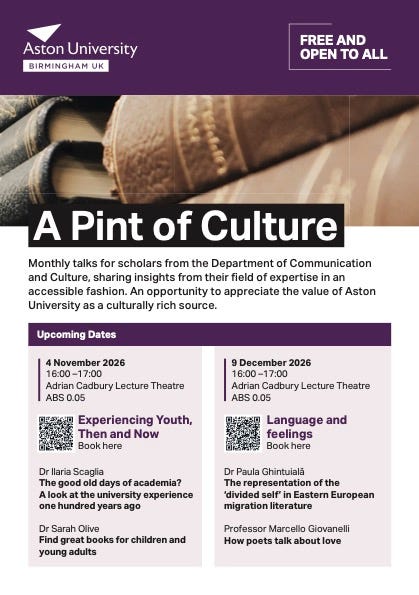
The conference will examine the effects of geopolitical tensions and the complex challenges they pose for businesses. Topics will include the politicisation of marketing activities, colonial dependencies and processes of independence, as well as the consequences of disruptions to or diversions of trade flows, shortages of raw materials or labour, and other forms of political intervention. We cordially invite you to contribute to the conference by presenting a paper. The full Call for Papers, including further details, is attached and available at the following link: https://unternehmensgeschichte.de/EBHA2027#CfP We would also be grateful if you could share the Call for Papers with interested colleagues in your network. The deadline for submissions is 31 January 2027. Applicants will be notified of the Programme Committee’s decision by 15 March 2027. We look forward to receiving your submissions and to welcoming you to Berlin for three days of stimulating discussion in August 2027. 5. Aston University Public EventsOn Wednesday 4 November the Department of Communication and Culture will inaugurate a new talk series entitled “A Pint of Culture.” Attached is a flyer with the first two. You can sign up here: Experiencing Youth, Then and Now These events are free and open to the public, please join us and encourage others to do the same!
You're currently a free subscriber to History in Organizations. For the full experience, upgrade your subscription.
|









No comments:
Post a Comment